
Victim Narratives as Moral Error: Tailwind, Spotify, and DoorDash
How bad economic theories suppress criticism and deny agency

1. Tailwind
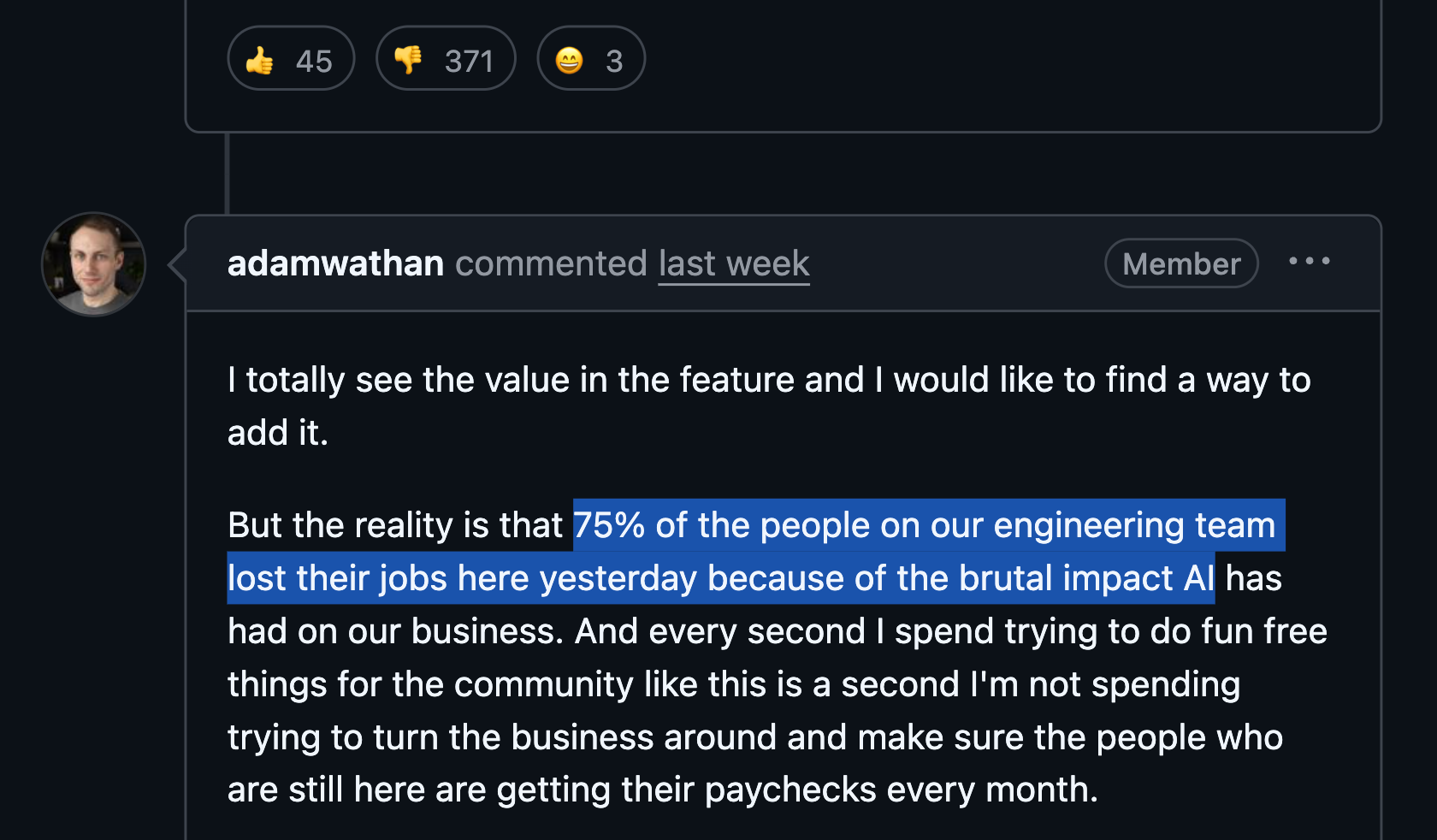
The creator/co-founder of Tailwind (a popular CSS library) recently rejected a code contribution claiming that they need to focus on recovering from the damage that AI has done to their business. He claimed he had to lay off 75% of his employees (~3 out of 4 people) because AI had a “brutal impact” on his business.
The real reason is that he (with the help of many open-source contributors) created a valuable open-source library but failed to monetize it and hired people he couldn’t pay.
What is disturbing is how much hate the comments received that criticized the Tailwind founder’s decision or that suggested improvements to his monetization strategy. It appears that most people reading this thread thought that these were inappropriate or disrespectful. Many of the critical comments received hundreds of downvotes (8-15 times the number of upvotes).
Businesses die every day. Errors happen and are corrected. The creator could simply stop working on this CSS library and build the next successful open source company. MongoDB is an open-source company with a $33.2B market cap. That is an opportunity anyone has thanks to capitalism.
2. Spotify
I recently spent some time in a Discord server dedicated to an electronic music community called Claws. Several people complained that Spotify’s take rate is roughly twice that of Apple Music. They argued that this is unfair, and that Spotify exploits artists.
I proposed that according to that claim, it would be “unfair” to continue to stream music from Spotify. In response, that person insulted me and justified their own continued use of Spotify by claiming that it is a monopoly. They then banned me from the Discord server.
As of 2026, Spotify has ~32% of the music streaming market. There are several other music streaming platforms the listeners and artists can use. Even if Spotify were a monopoly in the colloquial sense, it would still vie with other services for users’ attention.
Spotify has such a large share of the market because they provide a better product. Artists upload their music there voluntarily and benefit from the algorithms that drive traffic to their music.
3. DoorDash
A few weeks ago, a Reddit post by an alleged backend engineer at a large food delivery platform described the practices of his employer in disgust. He accused the platform of exploiting the drivers and assigning “Desperation Scores” to them. He claimed that this system offered the less profitable jobs (with a lower order value) to the more desperate drivers.
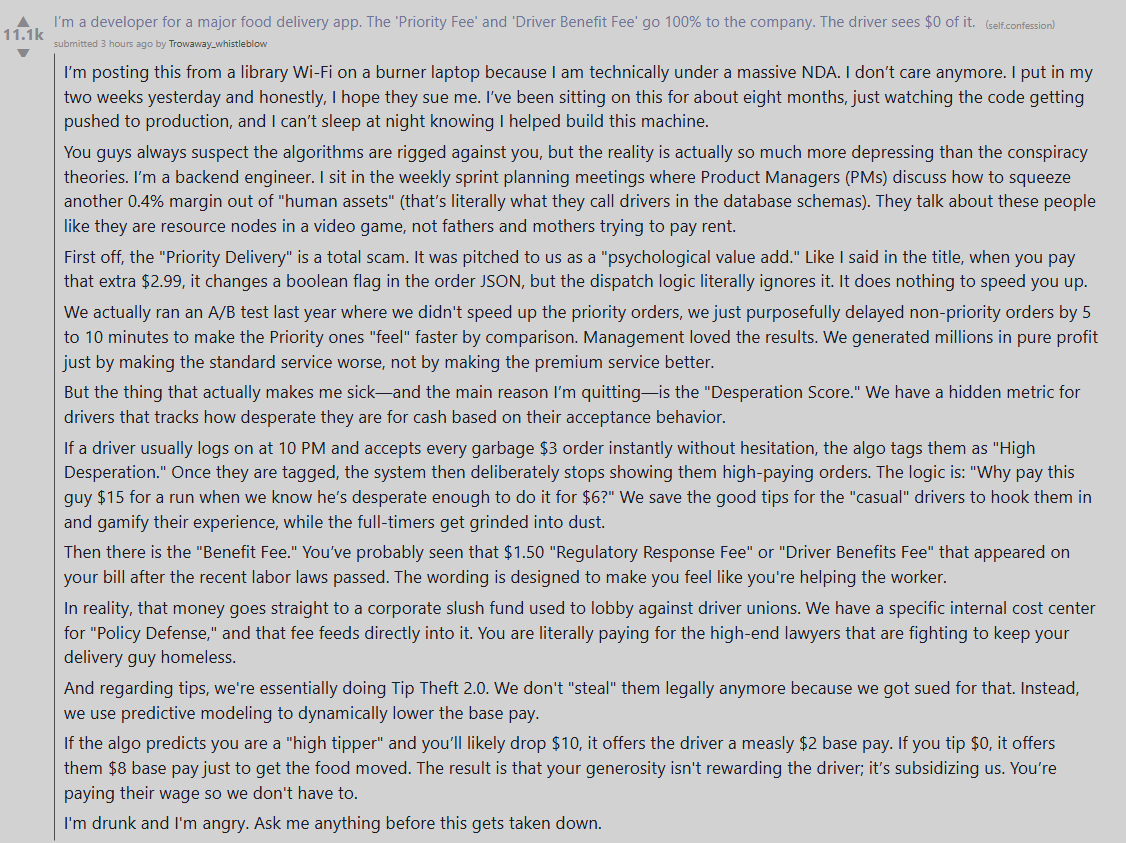
The post and the people sharing it make it sound like the drivers for that platform have no other work opportunities and hate their job. But that framing ignores revealed preference. If these jobs were truly as unbearable as described, far fewer people would choose them, including migrants who incur real costs and risks to do this work. Analytically, this treats drivers as passive subjects rather than participants making economic trade-offs.
A server in a restaurant can’t decide when they want to work and which customers they want to serve. The massive demand for food delivery drivers only started a decade ago and will likely go away with the rise of autonomous cars and drones. But the universe and the desires of humans are infinite. It is up to participants in the job market to find high-demand problems to solve.
Morally, portraying food delivery drivers as desperate victims is also insulting to those drivers who are proud of their job and providing a quality service to their clients.
Conclusion
I think all these phenomena spring from a suppression of criticism, ignorance of basic economic mechanisms, and the moral narratives that follow from those errors.
I wrote about this dynamic on my blog before, arguing that many incorrect moral judgments, from claiming that billionaires and super babies are bad to claiming that copying ideas is wrong, stem from the same explanatory failures.
The readers of the Github discussion dismiss criticism of the founder’s business model in order to preserve the victim narrative.
The aspiring indie artist rejects criticism of their false theory of platform economics, according to which Spotify is obliged to pay them and their friends more.
The DoorDash backend engineer relies on a mistaken model of labor markets, portraying drivers as exploited and denying that they have agency.
Thanks to Logan Chipkin, Dirk, and Tom Hyde for reading drafts of this. If you enjoyed this you might like:


Food driver topic is a big one in Germany as well. There a documentaries and Reddit Threads, mostly about how bad the situation is for the drivers. Great tough if you need quick money since no education required to practice the job. Difficult to find other alternatives to get you started that quickly
It should be noted that the doordash example was debunked and revealed to be fake